Storage that moves
as fast as your
operation does.
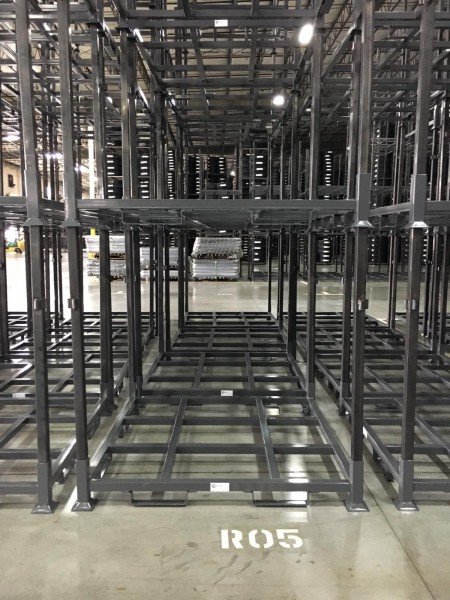
Industrial-grade portable stack racks —
forklift-ready, stack-able 4-to-5 high, no anchors, no permits.
Buy new, buy used, or rent for as long as you need them.
Stack racks aren't fixed pallet racking. They move, reconfigure, and disappear when you don't need them.
Three traits make our system different from anyone else's.
— 01
Easy to Set Up
Insert posts into the base sockets, lift with forklift or pallet jack.
No installation, no contractor, no permits, no permanent infrastructure
to walk away from.
— 02
Easy to Stack
Posts on the lower rack align with sockets on the upper rack. Stack
4-to-5 high with full forklift access from all sides — vertical density
without fixed pallet racking.
— 03
Easy to Store
Remove the posts, nest the bases. Empty stack racks collapse into a
footprint a fraction of their working size — no warehouse tax for
off-season inventory.
— 02 / What is a stack rack?
Freestanding steel storage that doesn't bolt to anything.
Stack racks are self-contained, forklift-handled steel units — a base, removable
posts or end frames, and (sometimes) fold-down sides. Unlike fixed pallet racking,
they require no installation, no anchors, no permits, and no permanent infrastructure.
Welded steel tubing for industrial duty cycles
Bases stack with posts inserted into integrated sockets
Different post heights store mixed product sizes on the same base
Total stack height up to 5× the smallest footprint dimension
Empty racks collapse for compact off-season storage
Operations that change shape — by season, by client, by SKU mix — get more value from
modular storage than from anything anchored to a slab.
— 01
3PLs & Pop-Up DCs
Stand up client space in days, not months. Reconfigure between contracts without writing
off fixed racking.
— 02
Cold Storage
Galvanized and powder-coat options for freezer and cooler environments. No anchors means
no slab penetration in temp-controlled rooms.
— 03
Manufacturing & WIP
Move work-in-process between cells without manual handling. Same rack, same load, fewer
touches.
— 05 / FAQ
Questions buyers usually ask.
Short answers — call us or send a quote request for anything specific to your facility.
General rule of thumb: total stack height should be no more than 5× the smallest
footprint dimension. A 40" × 48" base, for example, supports a stack up to roughly
16 ft tall before stability becomes the constraint. Aisles, forklift mast height, and
load type all factor in — we'll spec the right configuration with you.
No on both. Because stack racks are freestanding and forklift-handled, they don't
require permits, anchors, or permanent installation. That's the entire reason 3PLs and
short-term operations prefer them to fixed pallet racking.
Used inventory typically ships in 1-2 weeks, depending on quantity and location.
Custom new builds run 4-8 weeks depending on dimensions and load capacity. Rentals
can often ship within days if stock is available regionally.
Yes — that's one of the system's biggest advantages. Different post heights let you
store different-sized products in the same stack while sharing a common base. It's
common to order two or three post heights against a single base spec.
Standard catalog racks typically run from 2,500 to 4,500 lbs per unit, with stacked
capacities engineered to match. Custom builds can be specified higher for industrial
and automotive applications. Request a quote with your load requirements and we'll
confirm the right spec.
— 06 / Get started
Tell us about your load, your dimensions, and your timeline.
We answer every quote inside one business day. No call-center, no chasing — you'll hear back
from Morty or someone on his team with real numbers.